
How to Convert Temperature Coefficient
of a Solar Panel
Articles
How do you convert temperature coefficient from one unit to another? Such as %/C to %/mV? We'll go over how to:
- Convert %/C to %/K
- Convert mV/C to mV/K
- Convert %/C to mV/C
- Calculate a Tvoc from %/C to mV/C
- Calculate Tvoc from mV/C to %/C
It’s important to calculate the lowest and highest Photovoltaic (PV) voltage that is connected to a converting unit, whether that is a string inverter, solar charger, DC/DC converter.
The voltage (V) of a solar panel fluctuates inversely with temperature (T). What this means is as T↑ V↓ and T↓ V↑. This inverse relationship is indicated by the (-) sign in front of the temperature coefficient.
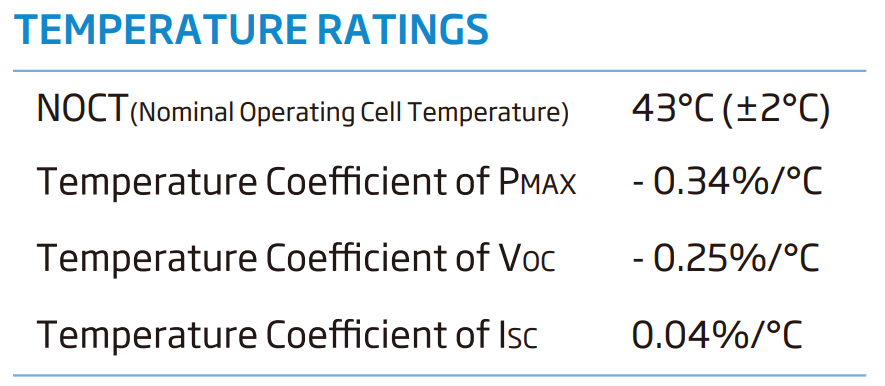
There are a couple of options to calculate the high and low voltages of a module. A common method is using the ambient temperature and temperature coefficient.
Calculating the voltage at the highest temperature would result in the module’s lowest voltage. The highest temperature must be calculated to ensure that the minimum voltage is above the converter’s start voltage or lower Multiple Power Point Tracking (MPPT) range. This guarantees that during the warmer weather, there is enough voltage to power on the converter and operate within its prime range.
Calculating the voltage at the lowest temperature would result in the module’s highest voltage. The lowest temperature must be calculated to ensure the maximum voltage is within the converter’s max voltage rating. Exceeding this voltage could cause damage to the inverter and void the warranty.
The temperature coefficient in a solar panel data sheet can be presented differently:
- %/C
- %/K
- mV/C
- mV/K
Here are some examples of how these temperature coefficients are presented:
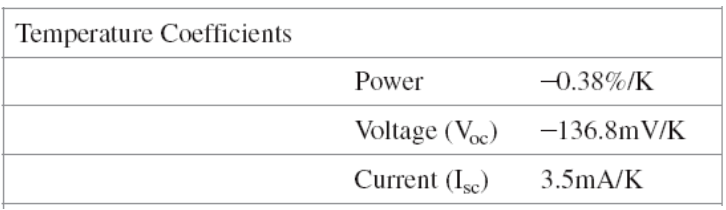
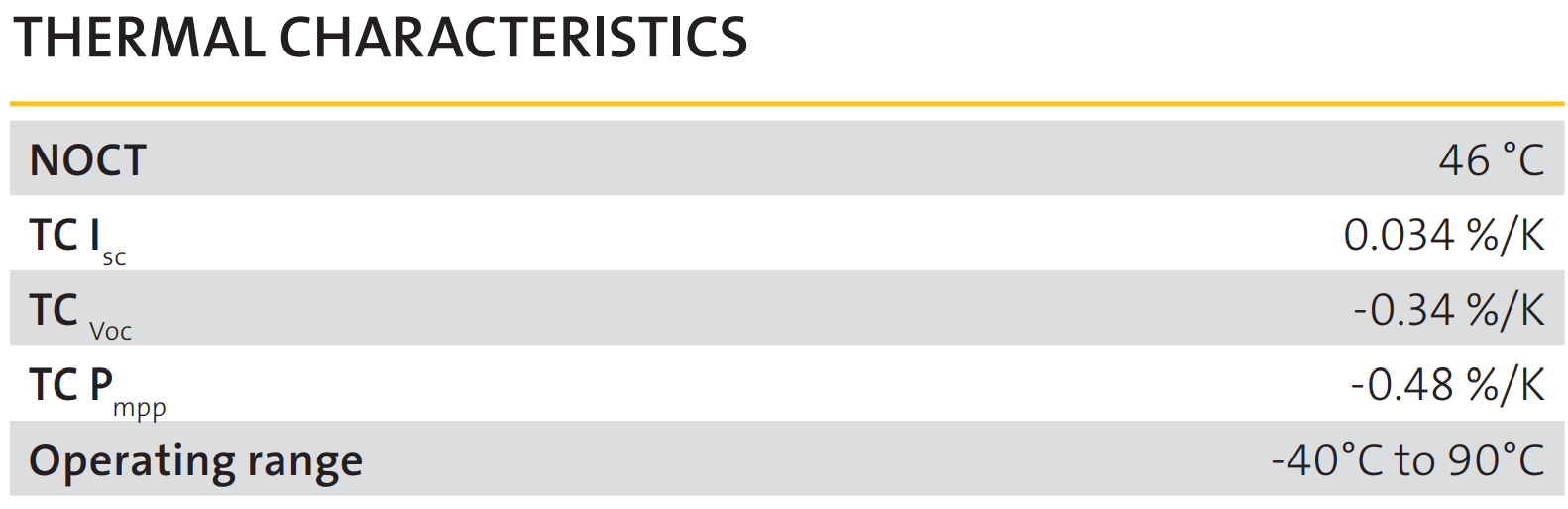
What does this mean? For the %/C and %/K, it means that for every Celsius or Kelvin from the nominal Standard Test Conditions (STC) cell temperature, the module voltage increases or decreases by a %. Standard Test Conditions are a set of base conditions that PV modules are tested at. This is used to rate the module’s performance. Irradiance and temperature at STC are: 1000 W/m², 25°C, respectively.
For the mV/C and mV/K, it means that for every Celsius or Kelvin from nominal STC cell temperature, which is 25°C, the module voltage increases or decreases by a number of mV.
How do you convert %/C to %/K? Easily, it is a one-for-one conversion. 0.25%/K can be displayed as 0.25%/C.
%/K = %/C
How do you convert mV/C to mV/K? Easily, it is a one-for-one conversion. 0.25mV/C can be displayed as 0.25mV/K.
mV/K = mV/C
How do you convert %/C to mV/C? In order to convert %/C to mV/C you will need the following:
- Voc or Vmp (sometimes referred to as Vmpp)
- Tvoc or Tpower, respectively
To calculate a Tvoc from %/C to mV/C you would use the Voc and the Tvoc in %/C. It's a similar calculation for the Tvmp:
(Voc × Tvoc / 100) × 1000mV/1V = mV/C
(Vmp × Tpower / 100) × 1000mV/1V = mV/C
To calculate Tvoc from mV/C to %/C you would use the Voc and Tvoc in mV/C. It's a similar calculation for the Tvmp:
((Tvoc × 1V/1000mV) / Vmp) × 100 = %/C
((Tpower × 1V/1000mV) / Voc) × 100 = %/C
Example 1: Convert Tvmp from %/K to mV/C
First, collect the following from the solar panel data sheet:
- Vmpp
- TC Pmpp
Note that for Tvmp, you use the Power coefficient. Solar panel datasheets sometimes call the same spec something different. For example, Vmpp may be called Vmp in another datasheet.
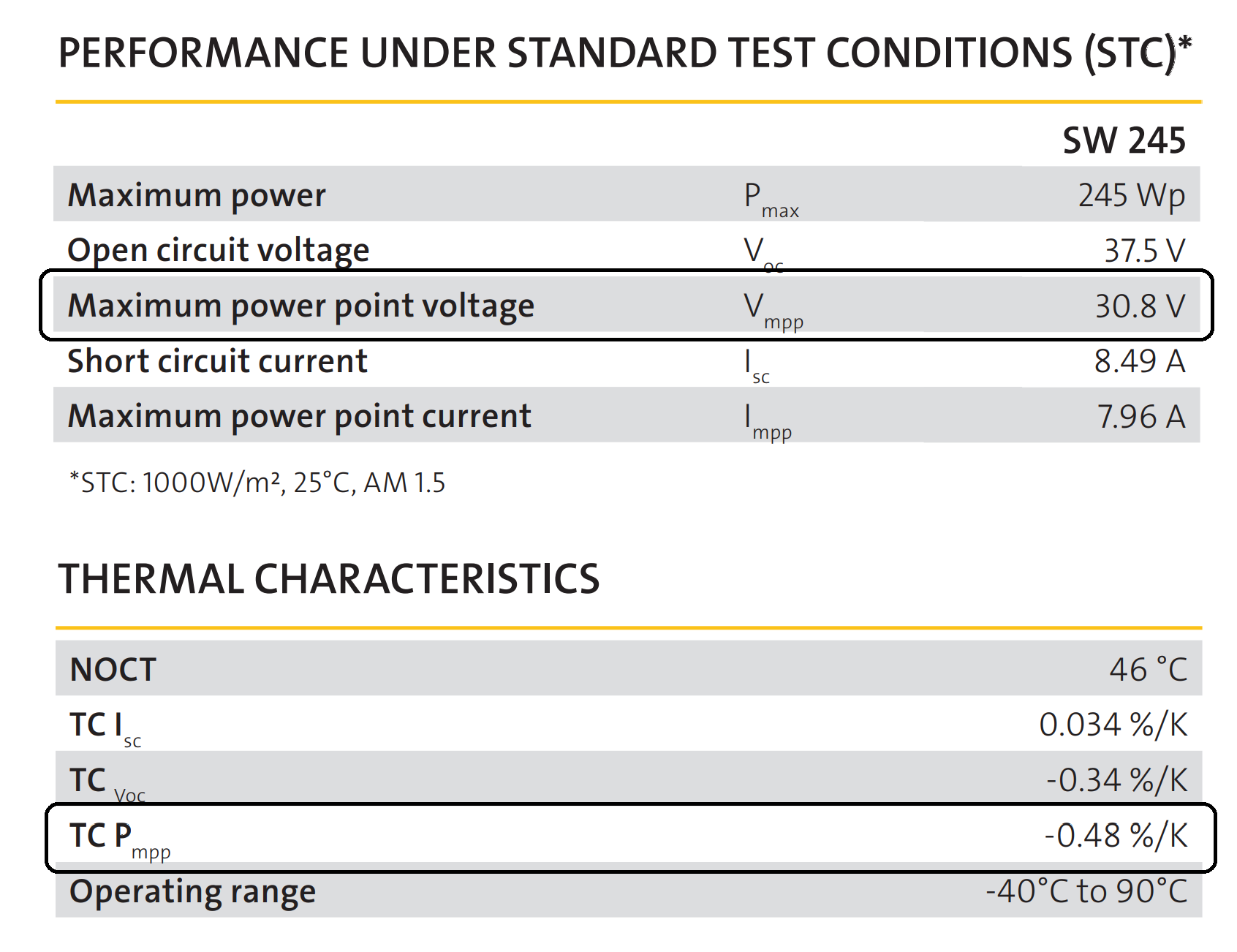
%/K = %/C
(Vmp × Tpower / 100) × (1000mV/1V) = mV/C
(30.8V × (-0.48%/C) / 100) × (1000mV/1V) = -147.84mV/C
Example 2: Convert Voc from mV/K to %/C
First, collect the following from the solar panel data sheet:
- Voc
- TVoc
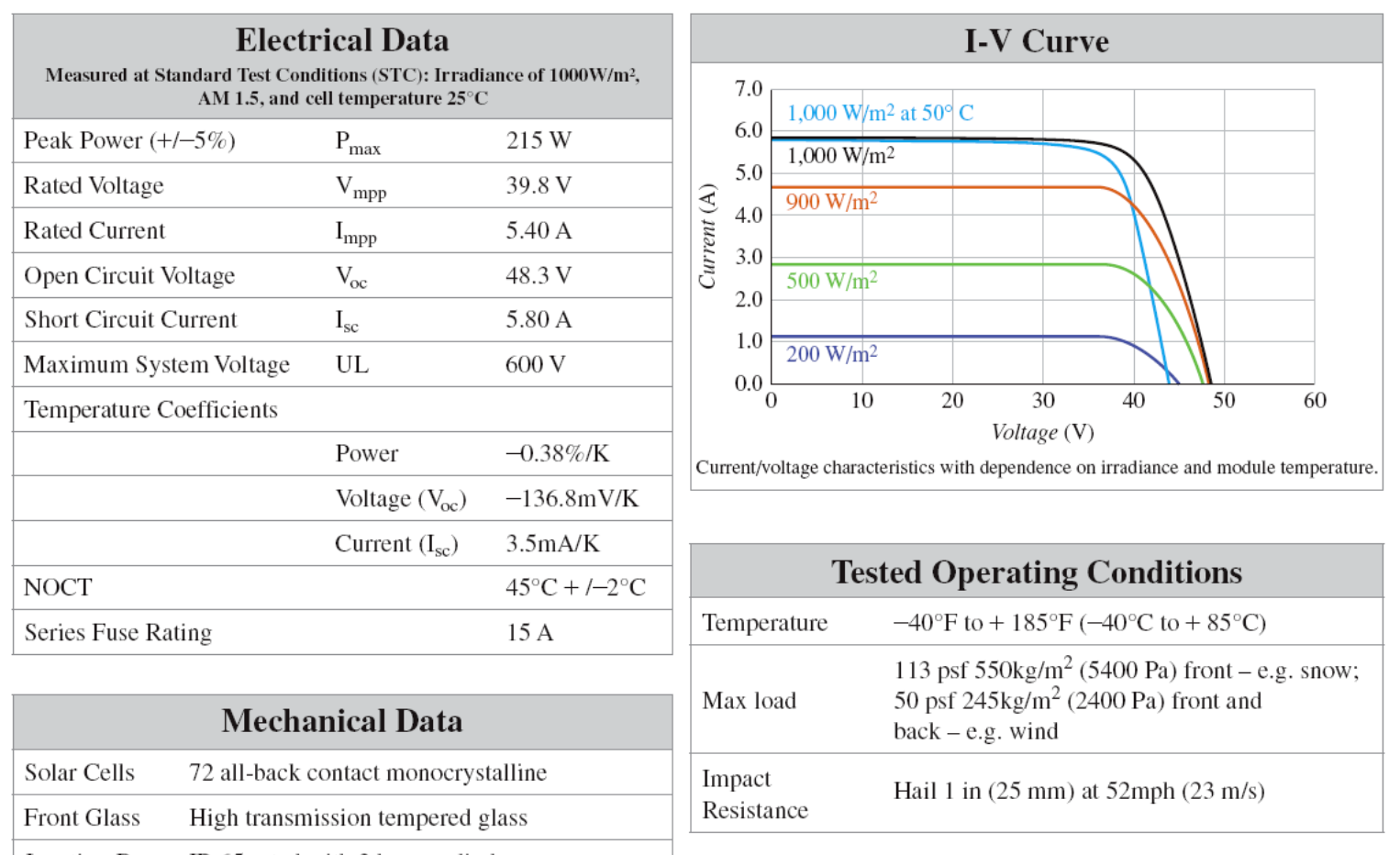
mV/K = mV/C
((Tvoc × 1V/1000mV) / Voc) × 100 = %/C
((-136.8mV/C × 1V/1000mV) / 48.3V) × 100 = -0.283%/C
Checkout the simple tool to do these calculations for you: mV/K or mV/C → %/C Converter Tool