How to Convert Temperature Coefficient
of a Solar Panel
Articles
How do you string size for your solar system? In summary we will:
- Identify inverter/converter limits
- Identify solar module limits
- Find site high and low temperature
- Calculate Lowest Voltage
- Calculate Highest Voltage
- Calculate Highest Number of Strings
- Calculate Total Max Number of Modules / Max power
- Iterate for the ideal array configuration
Module and Inverter Specifications
What does stringing modules mean in a solar powered system? Each solar module has two main attributes: voltage (V) and current (I).
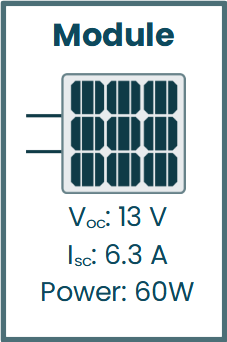
You may need to brush up on how electrical circuits work, but if you recall you may connect electrical components in series or in parallel.

Connecting a solar panel in parallel connects multiple strings together. Electrically, this means that the voltage of each string remains the same, but the current increases by the number of strings you have connected together. In the case below, the current from each string of 6.3 A is multiplied by 2 strings which would be 12.6 A total at the point of connection.
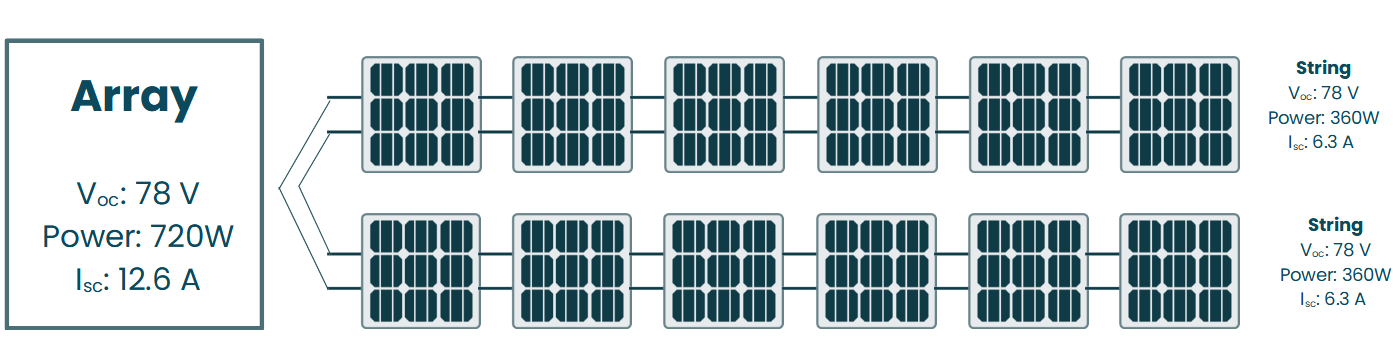
The combination of connecting solar modules in series and parallel creates an array that will then connect to the inverter.
Inverters typically have 4 main specifications that need to be met as to not void the warranty and for maximum performance:
- Minimum Operating Voltage
- Maximum Open Circuit Voltage
- Max Short Circuit Current or Max Current
- Max Power
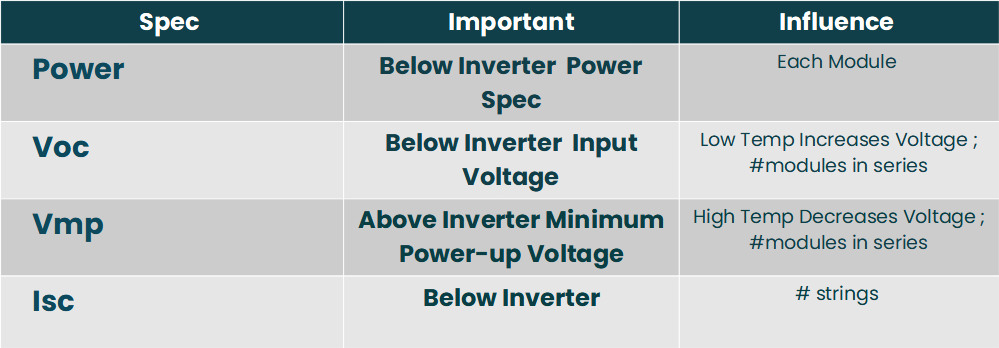
Most modern string inverters have a multiple power point tracking (MPPT) that operates within a specific voltage range.
Checking the minimum voltage does two things:
- Minimum Voltage is above the start-up voltage
- Minimum Voltage is within the lower MPPT range
Checking the maximum voltage does two things:
- Maximum voltage is below the inverter’s maximum (possibly damaging the inverter if not)
- Maximum voltage is within or close to the upper MPPT range
Checking the maximum Isc or maximum current does one thing:
- Maximum current is below the inverter’s maximum (possibly damaging the inverter if not)
Checking the maximum connected power is below the inverter’s max. This may be optional as some inverter manufactures have this specified and others do not.
Before string sizing we will need to check the inverter limits and peak performance ranges.
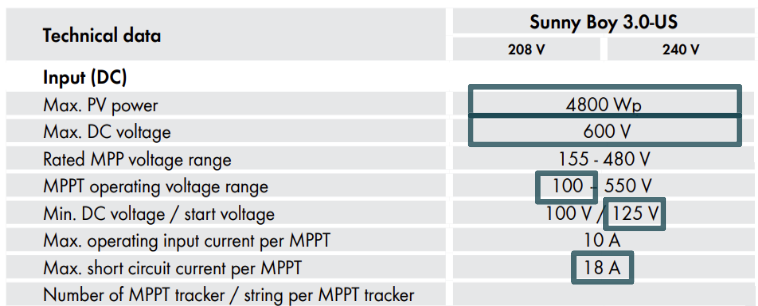
Max. PV Power: be sure that the total number of modules are below the inverter’s maximum.
Max. DC Voltage: be sure that the total modules in series are below, in this case, 600 V total.
MPPT operating voltage range / Start Voltage: be sure the minimum module voltage is above the operating MPPT lower range of the start voltage, whichever is higher. In this case it would be the 125 V.
Max. short circuit current current per MPPT: be sure that the total max current due to the number of strings connected in parallel per MPPT doesn’t exceed the Max short circuit current per MPPT. Now let’s take a look at the module data sheet for the important information for string sizing.
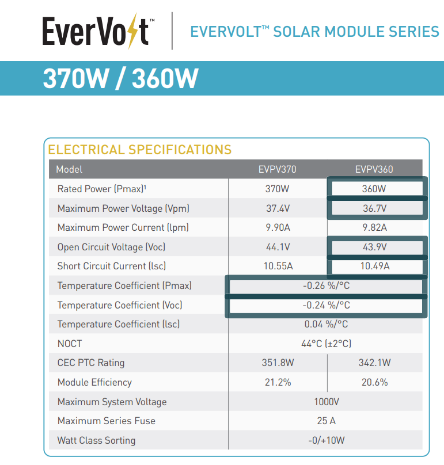
String Sizing Calculation
Calculate Lowest Voltage
Ensure that the lowest voltage during the highest temperature is within the start-up voltage and MPPT range.
Find the high ambient temperature for the site and calculate the low voltage per module using the following equation:
(( Thigh-25º ) * (%/C) * Vmp )+ Vmp = Vlow
Once you find this voltage, find the minimum start-up or MPPT voltage for the inverter and calculate the minimum string length.
(Inverter Min Voltage) / ( Vlow) = Minimum String Length
Calculate Highest Voltage
Ensure that the highest voltage during the lowest temperature is within the inverter’s max and near the upper MPPT range.
Find the low ambient temperature for the site and calculate the high voltage per module using the Voc and Tvoc with the following equation:
(( Tlow-25º ) * (%/C) * Voc )+ Voc = Vhigh
Once you find this voltage, find the maximum voltage for the inverter and calculate the maximum string length.
(Inverter Max Voltage) / ( Vhigh) = Maximum String Length
Calculate Highest Number of Strings
Inverters have a maximum current limit, exceeding this limit may damage the inverter and void the warranty. Inverter limits can be displayed differently, sometimes it’s Isc and sometimes it is max current (typically 1.25 X Isc).
From the example above, it specifies a maximum short circuit current.
(Inverter Isc Max) / (Module Isc) = Maximum Number of Strings
For inverter data sheets that specify a maximum current limit:
(Inverter Max Current) / (Module Isc X 1.25 ) = Maximum Number of Strings
Calculate Total Max Number of Modules / Max power
The inverter has a maximum PV power that can be connected to it. As we add modules, this increases the total power. We need to consider the maximum total number of modules that can be connected to the inverter. This may impact the number of strings or how how many modules per string you
(Inverter Max Power) / (Module Power) = Maximum number of modules
Iterate for the ideal array configuration:
After calculating the low and high limits, you now can finalize the array configuration within those limits along with other factors that may affect it. Some of these factors could be the module count that has already been purchased, physical space for modules, etc.
Lets run through an example.
Example
Location: Dixon, MO
Inverter: Sunny-Boy 3.0
Solar Module: EverVolt EVPV360
Calculate Lowest Voltage
Ensure that the lowest voltage during the highest temperature is within the start-up voltage and MPPT range.
The high ambient temperature for the site is found on energyresearch.ucf.edu and the 2% Avg. is 34º C.
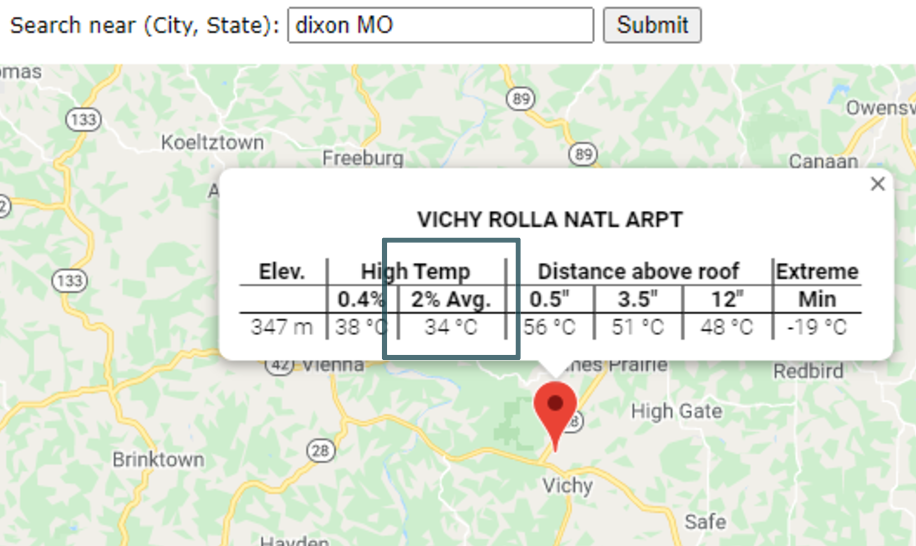
Calculate the low voltage per module:
(( 34º-25º ) * (-0.0026/C) *36.7V )+ 36.7V = 35.84 Vlow
Once you find this voltage, find the minimum start-up or MPPT voltage for the inverter and calculate the minimum string length. We round this number up.
(125 V) / (35.84) = 3.48 = 4 Module Minimum String Length
Calculate Lowest Voltage
Ensure that the lowest voltage during the highest temperature is within the start-up voltage and MPPT range.
The low ambient temperature for the site is found at energyresearch.ucf.edu and the Min is -19º C.
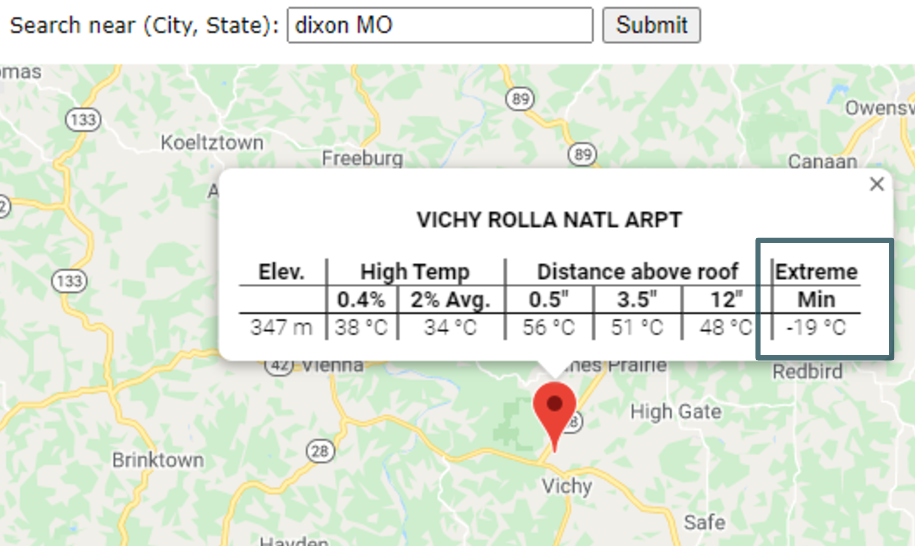
Calculate the high voltage per module:
(( -19º-25º ) * (-0.0024/C) *43.9V )+ 43.9V = 48.54 Vhigh
Once you find this voltage, find the maximum voltage for the inverter and calculate the maximum string length. We round this down.
(600 V) / (48.54) = 12.36 = 12 Module Maximum String Length
Calculate Highest Number of Strings
Find the inverter’s maximum current limit and the module’s Isc at STC. The inverter’s datasheet specifies max short circuit current per MPPT, so this is just Isc.
(18 A) / (10.49 A) = 1.72 = 1 String Maximum per MPPT
If the Inverter data sheet specifies a max current of 18A, for example, then you would need to calculate max current per NEC. One method of max current is 1.25 X Isc.
Calculate Total Max Number of Modules / Max power
Locate the inverter’s maximum PV power and the module’s power.
(4800 W) / (360 W) = 13 Maximum number of modules total
Iterate for the ideal array configuration:
After calculating the low and high limits, you now can finalize the array configuration within those limits. Here are the results we calculated:
Minimum String Length: 4
Maximum String Length: 2
Maximum Number of Strings: 1 Per MPPT
Maximum number of Modules 13 Modules
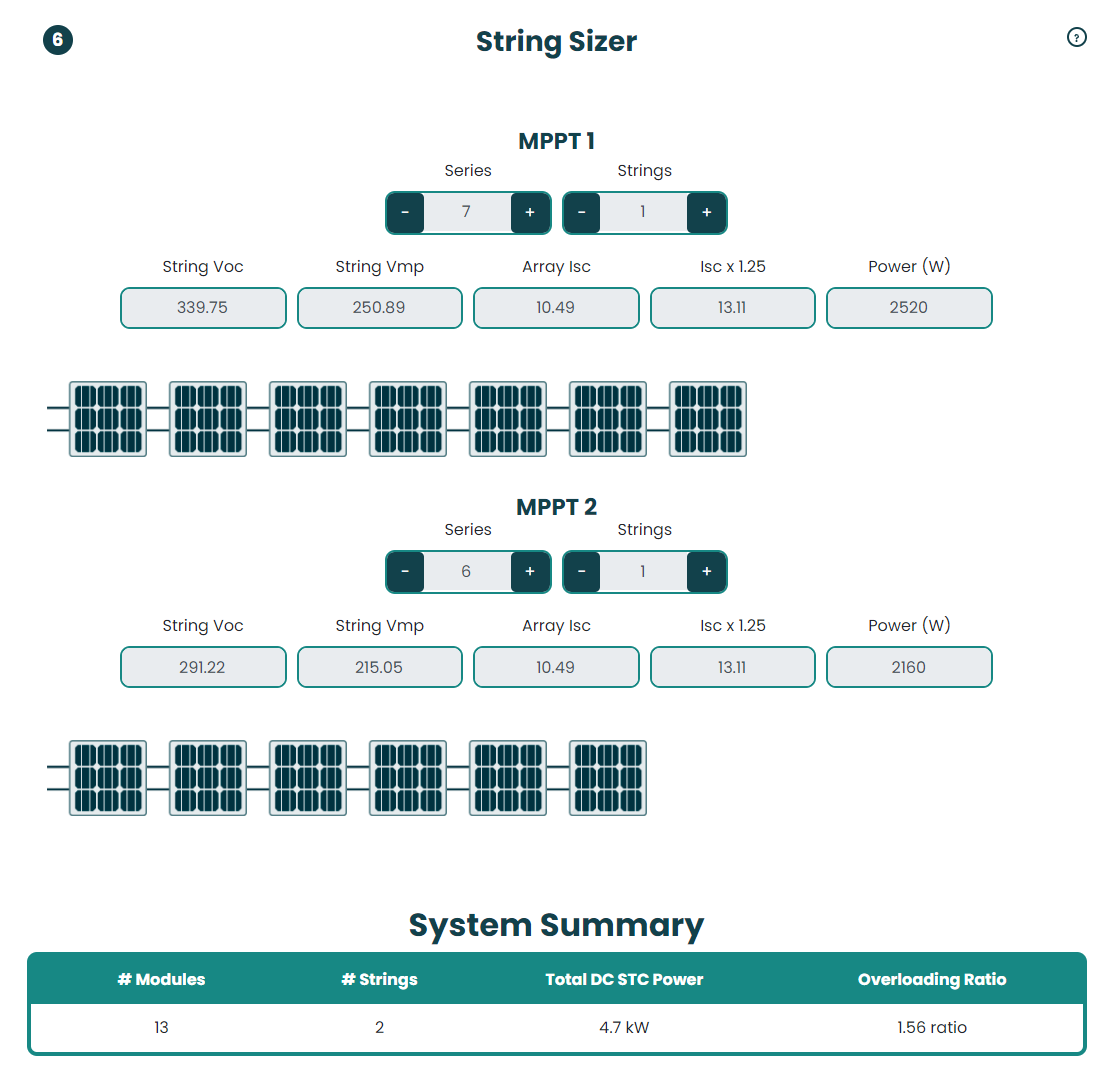
This inverter has 2 MPPT trackers, so a total of 2 strings can be connected to the inverter. We know that there can only be 13 modules maximum installed. We can have one MPPT with 6 modules in a string and the other at 7 modules in a string.
Results
Check out UpTop Solar String Sizing Tool that does this for you!