
How to Convert Temperature Coefficient
of a Solar Panel
Articles
Maximum Power Point Tracking (MPPT) is a solar inverter function that manipulates the operating voltage of the module in order to reach the maximum power output. In order to understand maximum power point, you need to first understand the I-V curve of a solar module
Solar modules have two distinct properties: current (I) and voltage (V). If you recall from physics class:
Power = I X V
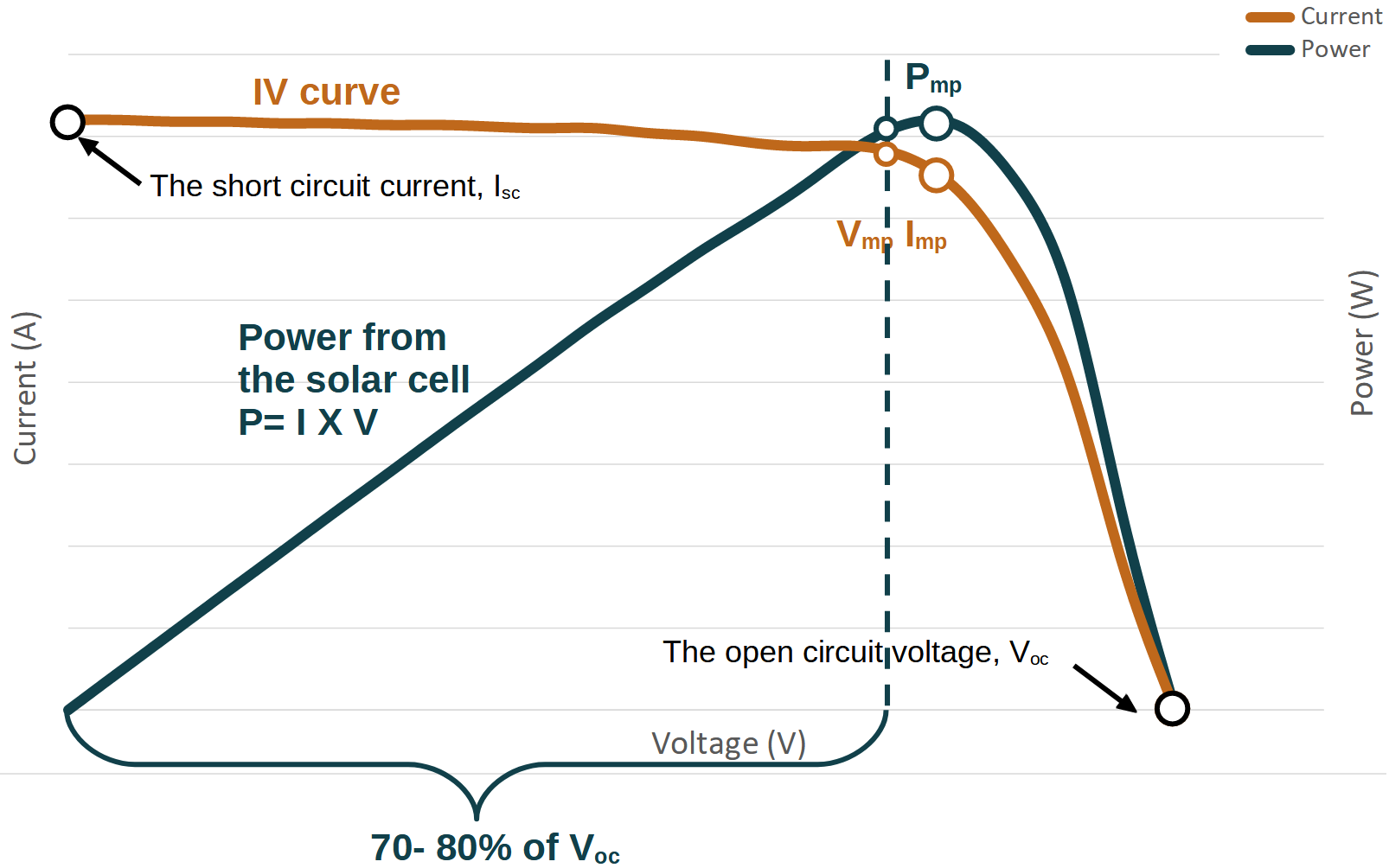
Each solar module has an I-V curve that describes the current and voltage relationship at a certain irradiance and temperature. At one end you have a short circuit current (Isc), this is when there short between the positive and negative terminals. This represents a voltage at 0 V and the highest amount of current. The other end is the open circuit condition which is when there is no load and an open circuit condition. This represents a current of 0 A and the highest voltage.
On this I-V curve you could multiply each points I and V values to get power. You can see this power curve mapped on the same graph.
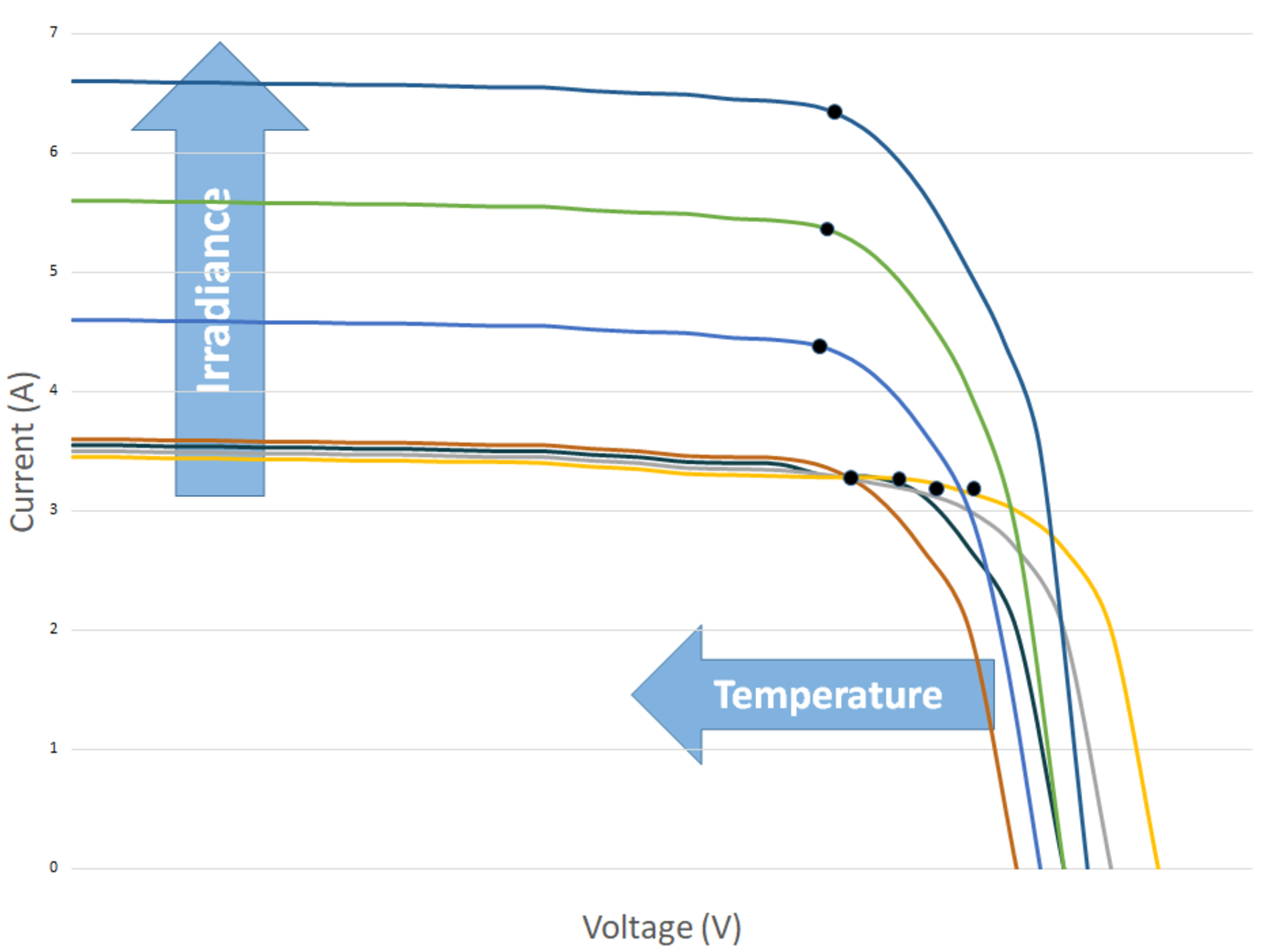
This curve can shift, depending on the irradiance and temperature acting on the module. As irradiance increases, current increases and voltage increases slightly. Temperature only affects voltage and has an inverse relationship to it; as temperature increases, voltage decreases and vice versa.
Maximum power point tracking manipulates the module voltage with the goal to be at or near the maximum power point for the current conditions. See Figure 1 Vmp and Imp that produces Pmp (maximum power).
The MPPT inverter methods to find the maximum power point can vary. Some methods include:
- Fixed voltage method
- Percent open circuit voltage method
- Perturb and observe method
Fixed voltage method
Set the operating voltage to one fixed value that is close to MPP. typically 70%-80% of a measured Voc. Once this voltage is set, it will always use this voltage no matter the changes in irradiance or temperature. It's possible to set this seasonally. This method is not very accurate and is better for minimal irradiance fluctuations on a particular day.
Vmp is Typically 70%-80% of Voc.
Percent open circuit voltage method
This method takes advantage of the fact that an approximation of Vmpp can be made from a % of the Voc. This is usually around 70%-80% of Voc, depending on PV technology. This technique is a good balance between accuracy and ease of implementation.
Downside is that this percent method is an approximation. It most likely doesn’t find the MPP exactly. How does the MPPT find the present Voc considering the conditions? The inverter would need to temporarily disconnect the PV to measure the Voc. There would be production losses during that short time to measure the Voc.
Unlike the fixed voltage method, this method can change the Vmp approximation with temperature and irradiance changes everytime it measures the Voc.
Perturb and observe method
This method relies on direct measurement of current, voltage and power. Perturb means to influence a system from its “normal” state and observe the results. The inverter’s MPPT function “influences” the module voltage in order to see if it improves the power output or worsens.
If the voltage increases and it leads to a higher power, this means that the previous operating point is to the left of the MPP and it should try again at a higher voltage. Now, if it increases its voltage again and it decreases in power, this means that the MPP is in between the last point and the new point. This iteration continues until the algorithm converges to the MPP.
This method has its downsides. For example if the irradiance were to change in the middle of this algorithm this could cause possible false improvements or appearance of false performance degradation. If this were to happen, it would just take longer for the algorithm to converge to the MPP.
Conclusion
There are many different methods to Maximum Power Point Tracking that are not covered in this article. As you have learned, some methods implement maximum power point tracking more accurately than others. The simpler methods has are less complex, however can be less accurate and don't adapt to environmental changes such as temperature and irradiance. The more dynamic algorithms may be more accurate, but require more development, testing and processing power. All mehtods have the ultimate goal of manipulating the module's operating voltage to maximize the power from the module to fully utilize its capability.